
Still Burning
A workshop for ceramic sculptures
For centuries, candelabras have carried light, faith and memory. Now you build one for your grief.
At a glance
- Duration
- Three evenings: two making evenings of 3 hours, four weeks apart, plus an evening to collect and light it for the first time. At most 10 people
- Language
- German and English
- Price
- €125
- Included
- Clay, glaze and firing
- Place
- In Kreuzberg. You’ll get the exact address after you sign up.
- Dates
- None planned yet. I announce new dates in the newsletter.
Why candle holders
Lighting a candle for someone. People have done this for as long as there have been candles. As a prayer, as a greeting, as a silent I’m thinking of you. But after a few hours the candle is gone. The holder stays. It holds together all the candles that come after it.
For a long time there was a very plain, ordinary candle on my altar. Until I found these candle holders in a small ceramics shop in Berlin. Butterflies, a bit crooked, beautifully chaotic. I knew straight away: they belong on my altar. Because they don’t just hold a candle. They carry meaning too.
Read more
Candelabras exist almost everywhere people have rituals. The menorah with its seven branches. The Schwibbogen of the miners in the Ore Mountains, born from a longing for light. The Árbol de la Vida in Mexico, a tree of life made of clay that grew out of ceremonial candelabras. A candelabra never holds just a candle. It holds on to what we believe in, what we celebrate and whom we miss.
And every candle that burns in it leaves something behind. The wax runs down, drips, hardens. The next candle burns on the remains of the last. Burning, collapsing, building up. Somehow a beautiful description of grieving.
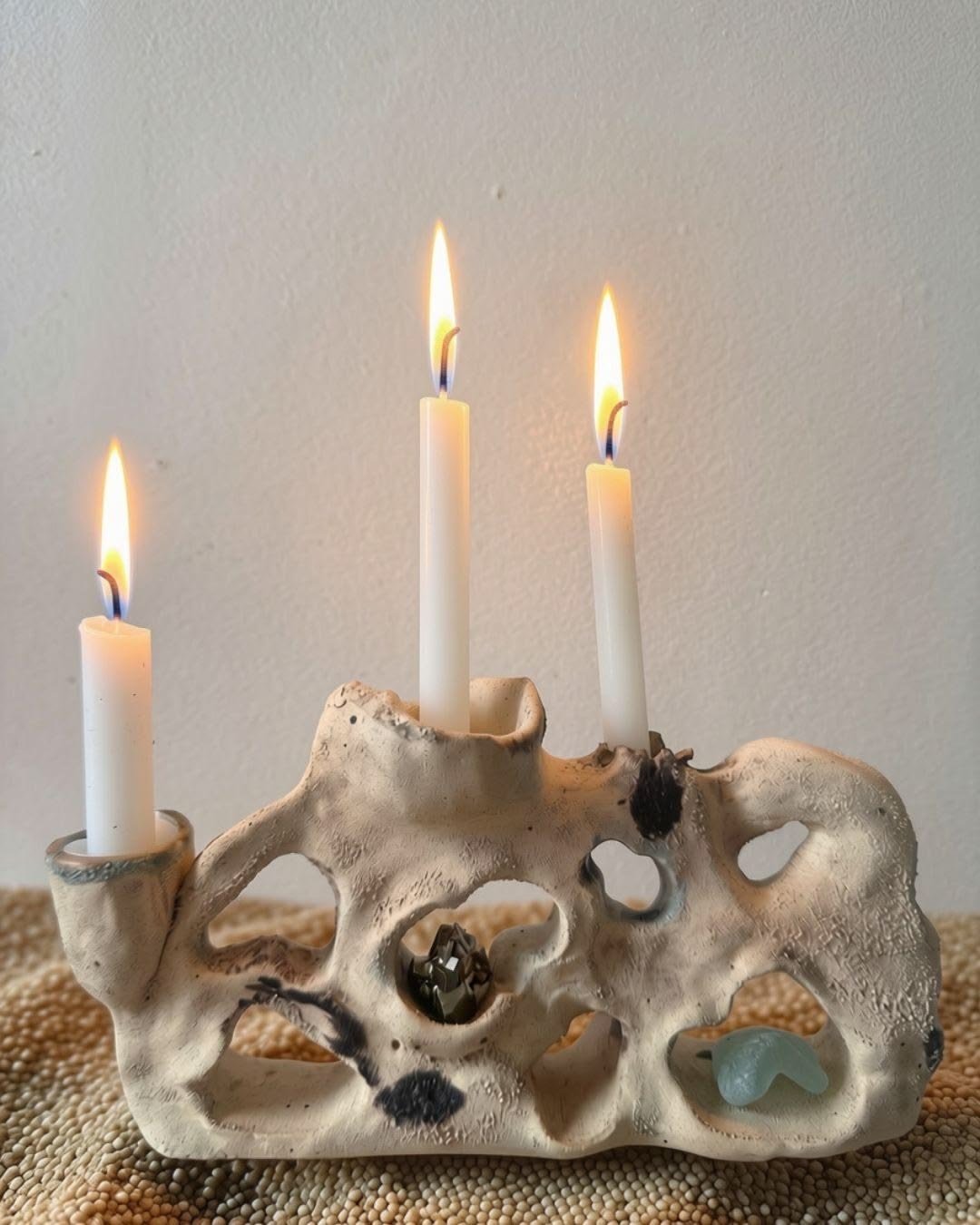
In this workshop you build your own candle holder. How many arms should it have? Which symbols belong on it? Will it be simple, colourful or really strange? Maybe it’ll be a blob. Maybe a heart.
What we do
Beforehand we send you a small collection for inspiration. Candle holders from different times and cultures, everything such a thing can be.
On the first evening we start with symbolism and form. What should your candle holder carry? Then we work with clay. Paula shows you how to build a candle holder that stands well and holds a candle safely. And then you build yours. With shapes that belong to your person, to your loss, to your grief. You can carve something into it, a date, a pattern. Or press something in: a leaf from the garden, a button from his jacket, the fabric of her favourite dress.
Read more
Then the clay has four weeks. It dries, and Paula fires it for the first time.
On the second evening you glaze your candle holder. Which colours? Glossy or matt? Where may it run? Then it is fired a second time.
On the third evening you pick up your finished candle holder, and Paula and I lead a ritual. We light the candle holders for the first time. All of them stand together, the lights go out, and everyone lights their own candles. For whom, you don’t have to say. Then we let them burn. We watch the wax run, the candles lean, sink into themselves and drip onto each other. None of it is wiped away.
You take your candle holder home, with the first layer of wax already on it. You don’t need any experience with clay.

With whom

Paula Klompmaker is an artist and art educator and lives in Leipzig. There she runs the ceramics workshop NØA in the Pittlerwerke, a place where art, craft and inclusion come together. At the association Wolfsträne she accompanies grieving children. Her own work is often about small details, about nature and about transience.
Voices
“I wanted to make something simple. In the end my candle holder had five arms and looked like a cactus. My mother would have loved it.”
Fiona
“I made seven small candle holders, no two alike. And each one tells in its own way how much I love my brother.”
Alejandra
“My candle holder turned out completely flat, with two huge arms. In between is the date we met.”
Filipe